
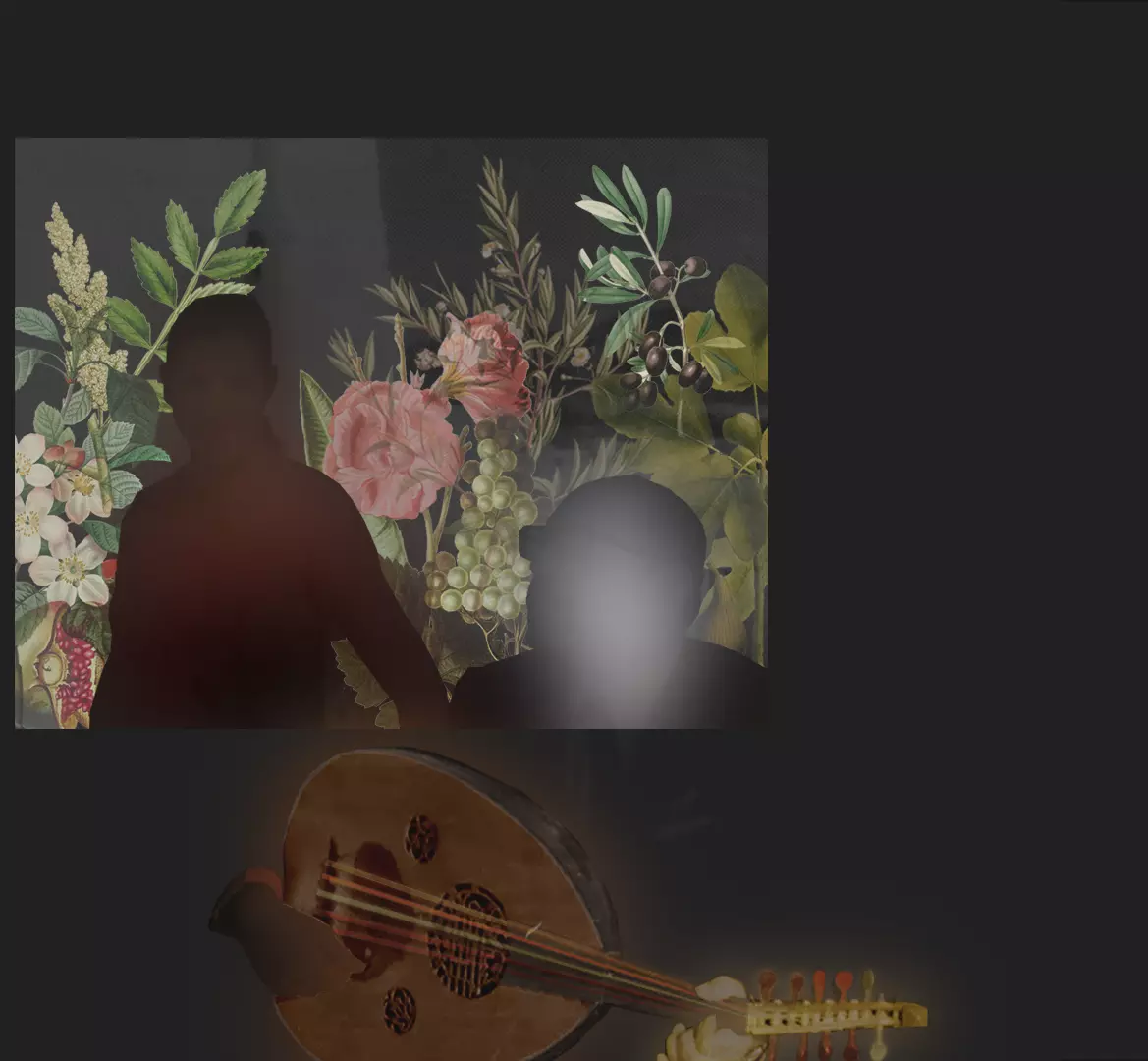
Itinerario botánico andalusí
Composition made for the Andalusian botanical itinerary promoted by Fundación de Cultura Islámica and the Museo Sefardí de Toledo in the framework of the Med-O-Med network. The commission was to compose a piece based on the botanical stories developed for the museum's new garden. The piece was presented live at the Synagogue of Transit in Toledo on May 17, 2025.


Compositional process
At a time when we are witnessing the passivity of the West in the face of the genocide that the Israeli state is committing in Gaza against the Palestinian population after decades of occupation and armed conflict, it has been very difficult to approach the Sephardic culture to compose this piece. But to imagine a past of coexistence in the Andalusian era and to think of a music for that historical garden seemed to me something worthwhile considering the approach of the project by the Islamic Culture Foundation and the Sephardic Museum.
From the compositional logic of Kleos the question has been: what would that garden-orchard sound like that the catalog of species chosen for the museum's garden defined.
Searching for sound recordings with which to compose has led me to music in which traits of that era have been maintained, which speak to us of the role of music that roots peoples expelled from their contexts. During the research process I have worked with more than 600 audios to weave sound connections between the Andalusian traditions in the Arab and Sephardic spheres:
- The maintenance of musical traditions by the Sephardic population in their diaspora after the expulsion from the peninsula (kantikas and Sephardic ritual music in Ladino): songs from the Sephardic music archive on 78rpm records, from the archive of documentation of musical memories 'Trezoro de kantes de sefarad' and musics appearing in the book 'Recording History:Jews, Muslims, and Music across Twentieth-Century North Africa' among others.
- The traces of Andalusian music structures and forms that have been maintained and developed in Arab music in different parts of the Mediterranean after their expulsion from the peninsula: Musical styles such as the Al-Âla (الآلة) in Morocco, Al-Gharnati (الغرناطي) in Algeria (Tremecén) or the Ma'luf (المألوف) in Tunisia, along with musical forms such as the Moaxajas (مُوَشَّح muwašššaḥ), Nubas (النوبة) or the Zejel (زجل). I have also used pieces by Palestinian musicians such as Rawhi al-Khammash or Riad al-Bandak who composed Andalusian forms and were expelled by the Israeli state from their land after the Nakba in 1948. The sound sources come from the archive of the Center for Arab and Mediterranean Music (CMAM), from the archive of the AMAR foundation or from the fantastic catalog of Les Artistes Arabes Associés among others.
The piece ends with Rawhi al-Khammash playing with a Sephardic woman recorded in Tetouan, raising the human and historical tragedy of thinking how the Israeli state can exercise against the Palestinian people a violence analogous to what the Jewish people have suffered in other historical moments. Composing this piece from a Spanish state whose history is partly that of the Moorish and Sephardic expulsion, and in which sadly we are now witnessing again retrograde and inhuman ideas about the migrant population by the extreme right, is hard and paradoxical.
Fuentes musicales
To compose this remix piece, 53 musical fragments from 29 songs have been used, here you can see what they are and listen to some of them.


- album: Odeon LA 202775
- artist: Isaac Algazi
- place: Esmirna, 1929
listen >
music in ladino
- album: Ahmed Shiki - l'arbre des 24 modes
- artist: Ahmed Shiki
- place: Marruecos, 2009
listen >
The Moroccan oud player Ahmed Shiki tries to reconstruct on this recording the old system of 24 modes (today only 11 suites or noubas are still practiced)
- album: Kol Ha'shofar (Call of the Shofar)
- artist: David Hausdorff(Rec.)
- place: Israel, 1957
[listen >](https://folkways.si.edu/david-hausdorff/the-three-shofar-sounds/judaica-sacred/music/track/smithsonian
- album: Columbia 12280 (22124/22126)
- artist: Isaac Algazi
- place: Esmirna, 1927
listen >
music in ladino
- album: Columbia 12278 (22055-1/22056)
- artist: Isaac Algazi
- place: Esmirna, 1927
listen >
music in ladino
- album: Musique Arabo-Andalouse - Ecole De Tlemcen
- artist: Cheikha Tetma
- place: Tremecén, 1950?
listen >
- album: Kol Ha'shofar (Call of the Shofar)
- artist: David Hausdorff(Rec.)
- place: Israel, 1957
listen >
- album: Ahmed Shiki - l'arbre des 24 modes
- artist: Ahmed Shiki
- place: Marruecos, 2009
listen >
The Moroccan oud player Ahmed Shiki tries to reconstruct on this recording the old system of 24 modes (today only 11 suites or noubas are still practiced)
- album: https://folkmasa.org
- artist: Viktoria Israel
- place: Esmirna, 1978
listen >
Cantiga recorded by Moshe Shaul, https://folkmasa.org/avshir/shirp.php?mishtane=389
- album: https://folkmasa.org
- artist: Aflalo Meir
- place: Tanger, 1985
listen >
Cantiga recorded by Gladys Pimienta, https://folkmasa.org/avshir/shirp.php?mishtane=2248
- album: Music from the Middle East
- artist: Shelim Awwad and Yousif Naif
- place: Nazaret, 1967
listen >
Round dance performed by men as the dancers move round the singer and the piper with his double-reed pipe, mijwiz
- album: Folk Music of the Mediterranean
- artist: Unspecified
- place: Palestina, 1952
listen >
- album: Gramophone K-4608
- artist: Mahieddine Bachtarzi
- place: Argelia, 1929
listen >
Maqam Djarka with association AL-MOUTRIBIA, tradición andalusí
- album: CMAM archive
- artist: ‘Abd al-Ḥayy Ḥilmī
- place: Egipto, 1910?
listen >
A muwashshah in the Hijaz maqam and its quintet rhythm
- album: Nûbâ gharîbat al-husayns
- artist: Orchestre Al-Brihi de Fes
- place: Marruecos, 1989
listen >
- album: --
- artist: Riad al-Bandak(composer)
- place: Palestina, 1940?
listen >
Palestine musician that composed muwashsha pieces, he was related to Radio Jerusalem, but he was forced to flee his homeland as a result of the Nakba in 1948. He was exiled in Syria.
- album: La Niña De Los Peines – Canta - Volumen No. 2
- artist: La Nina de los Peines
- place: Sevilla, 1963
listen >
- album: Ahmed Shiki - l'arbre des 24 modes
- artist: Ahmed Shiki
- place: Marruecos, 2009
listen >
The Moroccan oud player Ahmed Shiki tries to reconstruct on this recording the old system of 24 modes (today only 11 suites or noubas are still practiced)
- album: Cheikh Raymond Music, Vol. 1
- artist: Cheikh Raymond
- place: Argelia, 1950?
listen >
- album: desconocido
- artist: Raoul Journo
- place: Túnez, 1955
listen >
Nacido el 18 de enero de 1911 en Túnez, en el seno de una familia judía de descendencia andaluza
- album: Columbia 12279 (22053/22131)
- artist: Isaac Algazi
- place: Esmirna, 1927
listen >
music in ladino
- album: desconocido
- artist: Rawhi al-Khammash
- place: Irak, 1960?
listen >
Palestine musician that composed muwashsha pieces, he was related to Radio Jerusalem, but he was forced to flee his homeland as a result of the Nakba in 1948. He was exiled in Irak.
- album: https://folkmasa.org
- artist: Tamar Martsiano
- place: Estrecho (Gibraltar), 2005
listen >
recorded by יואל פרץ
- album: Ballads, Wedding Songs and Piyyutim of the Sephardic Jews of Tetuan and Tangier, Morocco
- artist: Alicia Benassayag de Bendayam
- place: Tetuán, 1983
listen >
- album: Music from the Middle East
- artist: Sebag Yehuda
- place: Jerusalem, 1967
listen >
letra:'I saw a beauty with a beauty mark and black eyes...Oh, oh, the girl from Seville, she made me mad, she who was so beautiful.'
- album: Ballads, Wedding Songs and Piyyutim of the Sephardic Jews of Tetuan and Tangier, Morocco
- artist: Solomon Silboni
- place: Tetuán, 1967
listen >
Explaining to Henrietta Yurchenco how a melody was adapted for one of his songs, Siboni said: “the tune for this piyyut is a fast spanish dance, (and he illustrated) now I will slow it down, and it will sound right.”
- album: Eastern Mediterranean Judeo-Spanish Songs
- artist: Çakum Effendi
- place: Constantinopla, 1920?
listen >
Arboles lloran por lluvias, y muntañas por aires
- album: https://folkmasa.org
- artist: Saada Bendayan
- place: Tanger, 1978
listen >
Romance
- album: Ballads, Wedding Songs and Piyyutim of the Sephardic Jews of Tetuan and Tangier, Morocco
- artist: Female singer
- place: Marruecos, 1983
listen >
sidi: tratamiento de respeto entre los musulmanes y mozárabes de al-Ándalus
composition and collages: Ruben Alonso
Promoted by: The Andalusian botany itinerary installed in the Sephardic Museum is a project proposed by Fundación de Cultura Islámica (FUNCI), in collaboration with the Sephardic museum (Ministry of Culture)
nota: Unlike the rest of the Kleos compositions, I have not developed this one with my dear Nomad Garden, I have missed them...
year: 2025
